

IGCSE Physics Practical Skills 1: Measurement and Data Tables
Cambridge IGCSE Physics practical notes on scale readings, precision, repeated measurements, timing, data tables, and units for 0625 and 0972.
Every physics conclusion rests on measurements. A good result is not just a number. It has an instrument, unit, sensible precision, and method that another student could repeat.
These notes are independently written for Cambridge IGCSE Physics 0625 and 0972. They develop the practical skills named in the current syllabuses without reproducing Cambridge questions or mark schemes.
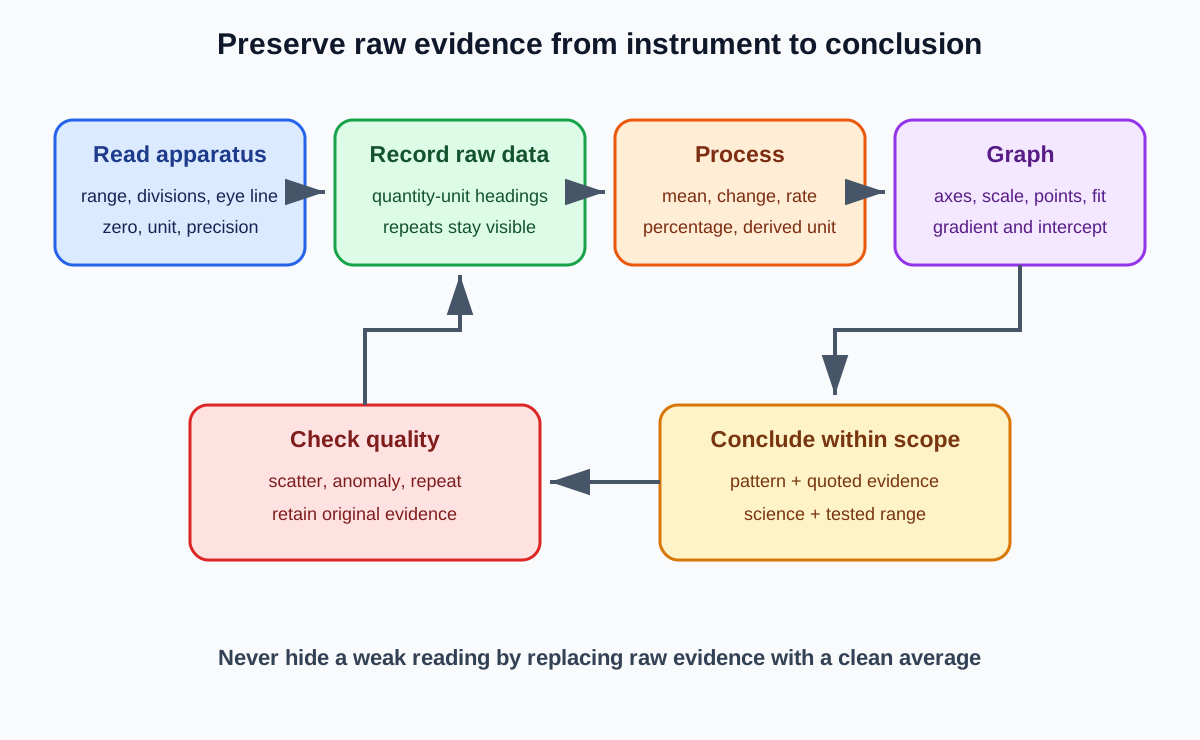
Read the instrument before the experiment
For each instrument, identify:
- the measured quantity
- the maximum and minimum useful reading
- the smallest scale division or digital step
- any zero offset
- the correct viewing position
A ruler might measure length to the nearest millimetre, while a stopwatch might display hundredths of a second. The displayed digits do not guarantee that human reaction time is equally small.
Avoid parallax with geometry
Parallax occurs when the pointer or object is viewed from an angle relative to its scale. Fix it by placing the eye directly in line with the pointer and scale.
For a ruler measurement:
- place the scale close and parallel to the object
- align one end with a convenient scale mark
- look vertically above the other end
- subtract the two scale readings if the object does not start at zero
Starting at a non-zero mark can be useful when the ruler edge is worn. The length is still the final reading minus the initial reading.
Deal with zero error
Check an instrument when the true input should be zero. If it shows a non-zero value, record the offset and apply the required correction consistently.
A zero check is different from repeating a measurement. Repeats reveal variation between readings. A zero check reveals an offset that may affect every reading in the same direction.
Improve timing measurements
Human reaction time can be a large fraction of a short interval. Increase the total timed interval where the phenomenon allows it.
For a pendulum:
- use a small release angle
- choose a fixed reference point
- time several complete oscillations
- divide the total time by the number of oscillations
- repeat the timing and compare results
Timing ten or twenty oscillations reduces the proportion of the result occupied by starting and stopping delays. It does not remove systematic mistakes such as measuring pendulum length from the wrong points.
Check this topic from memory
Attempt the matching topic bank before reopening the notes. Use each missed idea to decide what to review next.
Start the topic quiz