

IGCSE Physics Practical Skills 2: Graphs, Gradients and Relationships
Cambridge IGCSE Physics graphing notes covering axes, scales, best-fit lines, gradients, intercepts, transformed variables, and anomalous results for 0625 and 0972.
A physics graph is a measuring tool. It can reveal a relationship, reduce the influence of scatter, and provide a gradient or intercept used to calculate a physical quantity.
These original notes cover graph skills shared by Cambridge IGCSE Physics 0625 and 0972 practical assessment.
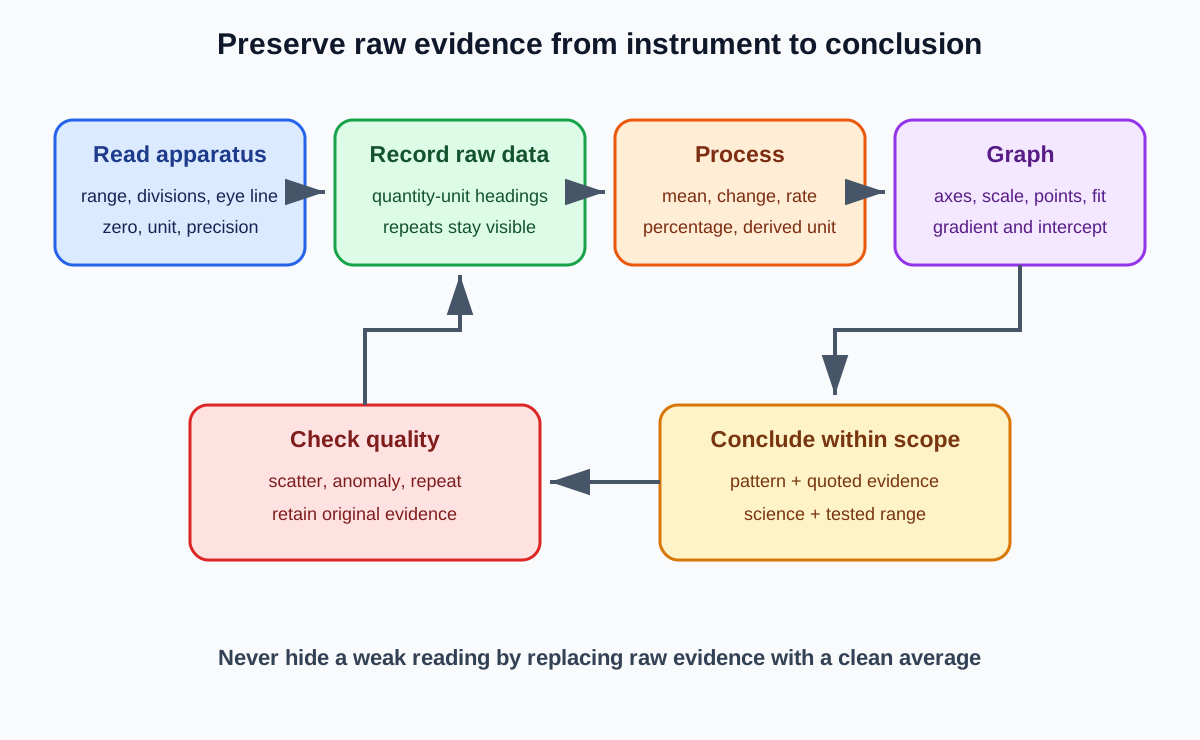
Decide what goes on each axis
Place the independent variable on the horizontal axis and the dependent variable on the vertical axis unless the question specifies another arrangement.
Label each axis with both quantity and unit, for example:
length / cmtime / spotential difference / Vcurrent / A
The unit belongs in the label, not beside every plotted value.
Choose a usable scale
A good scale:
- uses a large fraction of the available grid
- increases in equal steps
- uses intervals that are easy to subdivide
- includes every data point without crowding
The axes do not always need to begin at zero. However, a non-zero origin must be shown clearly and must not distort the interpretation required by the question.
Avoid awkward jumps such as three grid squares for seven units. Simple steps make plotting and checking more reliable.
Plot points precisely
Use small crosses or another clear convention. Locate each coordinate from the scale, not from the position of nearby points.
After plotting:
- count the points against the number of data rows
- check the smallest and largest coordinates
- inspect any point far from the emerging pattern
- recheck the table before calling it anomalous
A transcription error is not an anomalous experimental result. Correct the plotted value if the table was copied incorrectly.
Best-fit line or curve
A best-fit line represents the overall trend. It is not a dot-to-dot path.
For a straight-line relationship, draw one thin line with a balanced distribution of points around it. Do not force it through the origin unless the evidence or physical model requires that.
For a curved relationship, draw one smooth curve that follows the pattern. Sudden corners usually reflect point-to-point joining rather than the underlying physics.
Calculate a gradient
Check this topic from memory
Attempt the matching topic bank before reopening the notes. Use each missed idea to decide what to review next.
Start the topic quiz