IGCSE Physics Practical Skills 4: Planning and Evaluation
IGCSE Physics Practical Skills 4: Planning and Evaluation
Study guide/
A Cambridge IGCSE Physics framework for planning investigations, choosing variables and ranges, controlling measurements, analysing data, and writing specific evaluations for 06...
A physics investigation should test one relationship with measurements capable of showing whether that relationship is present. Planning is therefore about evidence, not merely listing apparatus.
These original notes support Cambridge IGCSE Physics 0625 and 0972 practical assessment without reproducing an examination task.
Convert the question into variables
Write the investigation as:
How does the independent variable affect the dependent variable when the relevant control variables are kept constant?
Then define how each variable will be changed or measured.
For a cooling investigation:
independent variable could be the insulation thickness
dependent variable could be temperature decrease after a fixed time
controls could include liquid volume, container, starting temperature, room conditions, and time interval
Naming a control is not enough. Say how it will be kept constant.
Select apparatus by range and resolution
Choose equipment that can measure the expected values safely and distinguish meaningful changes.
A ruler must be long enough for the largest length.
A stopwatch method must produce an interval large compared with reaction time.
A meter range must contain the expected electrical reading.
A thermometer must cover the expected temperatures with useful scale divisions.
When justifying a choice, connect the instrument property to the measurement. "More accurate" alone is incomplete.
Use enough values
Several values across a suitable range reveal a relationship better than only two end points. Choose intervals that are practical to set and measure.
The range should not:
exceed equipment limits
create an unsafe condition
make the response too small to resolve
make the response happen too quickly to measure
If a preliminary reading shows that the range is unsuitable, refine it before collecting the full set.
Write the method in operational order
A repeatable plan states:
how the apparatus is assembled and aligned
how the independent variable is set and measured
how control variables are held constant
Check this topic from memory
Attempt the matching topic bank before reopening the notes. Use each missed idea to decide what to review next.
Do not write "measure accurately" where you can name the action, such as reading the ruler vertically from above or using a fiducial marker for timing oscillations.
Plan reliability checks
Repeats at one condition reveal variation. More values across the independent-variable range reveal the shape of a relationship. These solve different problems.
Include both where appropriate:
repeat readings at each value
compare the spread
calculate a mean from consistent readings
investigate a suspected anomaly
plot all justified processed results
Decide the analysis before collecting data
State whether the evidence will be:
a direct comparison
a mean
a calculated quantity
a graph and gradient
a graph and intercept
a check for proportionality
If the final conclusion depends on a gradient, identify the axes and the physical meaning of the gradient in the plan.
Write evaluation as a chain
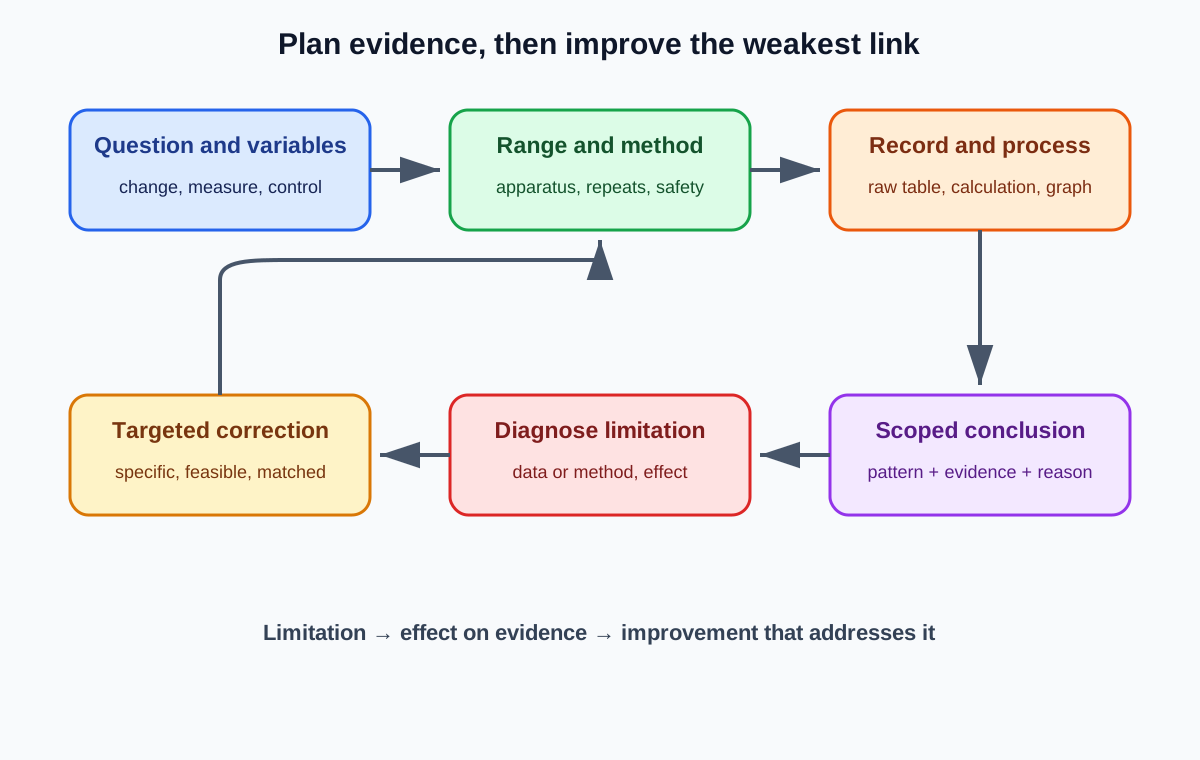
Use limitation, effect, improvement.
Limitation: the pendulum is released by hand from slightly different angles.
Effect: the motion is not started under identical conditions, increasing scatter in the period readings.
Improvement: use a fixed angular marker and release without pushing.
Limitation: temperature is read only once after removing the heater.
Effect: cooling during the delay makes the recorded peak temperature too low.
Improvement: record temperature continuously and estimate the peak consistently, or reduce the delay using a fixed measurement procedure.
Limitation: a short distance is measured with two thick reference markers.
Effect: the end positions are difficult to define relative to the measured length.
Improvement: use fine fiducial markers and measure between consistent reference points.
Separate random and systematic effects
Variation between repeats suggests a random component. A shift affecting every reading in the same direction suggests a systematic component.
Repeating and averaging can reduce the effect of random variation on the mean. It does not correct a ruler with a zero offset or a thermometer that is consistently miscalibrated.
Compare results within experimental resolution
Two measured values need not be numerically identical to support equality within the experiment's resolution. Compare the difference with the size and spread of the measurements rather than demanding exact matching.
At this level, a sound conclusion should state the observed relationship and refer to the data or graph. Do not add a causal explanation that the measurements did not test.
Worked application: turn evidence into a conclusion
Suppose a candidate investigates how one controlled change affects a measured physics quantity in IGCSE Physics Practical Skills 4: Planning and Evaluation. The plan names the independent variable, gives a sensible range with at least five values and states how the dependent variable is measured. Other relevant factors are held constant. Raw readings are recorded with units and consistent precision, repeated where scatter is plausible, then processed into a graph or derived quantity. The conclusion describes the observed relationship and cites the trend rather than saying only that the prediction was correct. An evaluation identifies a specific limitation, explains its likely effect and proposes a practical improvement that directly reduces that limitation.
Connect planning, measurement and evaluation
The strongest practical answers form one chain. The question determines the variables; the variables determine the apparatus and range; the apparatus determines resolution and plausible uncertainty; and the intended relationship determines the table, graph and calculation. Plan the analysis before collecting data so every required raw measurement is recorded. A derived quantity cannot be recovered reliably if one of its component readings was never taken.
Use repeat readings to expose random variation, not as a ritual. Repeats are most useful when a reading is difficult to judge, a time interval is short or the system fluctuates. If repeats are close, calculate a mean. If one value is anomalous, investigate it and repeat that condition rather than deleting it without justification. A zero error affects every reading systematically and is corrected differently from scatter.
Evaluation should name the route from limitation to effect. For example, a broad pointer makes a length endpoint uncertain, which creates scatter in the calculated gradient; replacing it with a thin fiducial marker reduces that reading uncertainty. Saying only "use better equipment" does not identify what becomes better or why the evidence improves.
Common misconceptions and corrections
Changing several variables together. Vary only the independent variable and control the other relevant factors.
Recording only processed values. Keep the raw readings, units and consistent precision needed to audit every calculation.
Drawing a dot-to-dot graph. Use an appropriate best-fit line or curve and identify anomalies from the overall pattern.
Calling every difference human error. Name the physical or measurement cause and explain its effect on the result.
Offering an improvement with no causal link. State the limitation, its consequence and how the change reduces it.
Assessment guidance
Paper 5 and Paper 6 assess the same AO3 reasoning even though one uses laboratory work and the other supplies experimental information. Read scales to the requested precision, include units in table headings and use most of the graph grid with a simple scale. Show gradient triangles and calculations clearly. Conclusions must refer to observations or numerical trends. Planning answers need operational steps, a suitable range, control variables, safety where relevant and a stated analysis method. Evaluation marks reward specific, feasible improvements linked to identified limitations, not generic instructions to repeat or be more careful.
Retrieval practice
Redesign the worked application for three different independent variables. For each version, list apparatus with range or resolution, five values, control variables, raw table headings, the expected graph and one safety control. Then diagnose one random and one systematic error, calculate a mean with an anomaly, describe a best-fit trend and write two limitation-effect-improvement chains.